record reviews
weblog talentspotter
features
links we like
about
us FAQ contact us
record reviews
weblog talentspotter
features
links we like
about
us FAQ contact us | instal |
|
Koji Asano, prolific composer and unassuming looking bloke with laptop, set the tone and threw down an enveloping sonic gauntlet. At first it was hard to tell which of the noises came from him and which were part of the background railway rumble above but the sound built relentlessly until it became a full spectrum, synaesthesia-inducing buffeting of the senses. With eyes closed the music, too structured and gentle to be noise, was truly hypnotic. I'm convinced it actually did carry me away into a trance, something often claimed but rarely accomplished. I'm suspended away from my body and I'm the one controlling the sound, all aural is there and it's just a matter of where (or whether) to focus my attention. I don't know how long he played for but I could have stayed there forever. While he played I was lost in some hippy blissed-out state and when he finished I was left in a daze, barely knowing where I was for a while afterwards. Seriously heady stuff. Koji Asano's sonic shadow fell long over the other artists. The two who suffered most from this were To Rococo Rot's Robert Lippock and ex-Ganger guitarist Rhomboi. The guitarist played immediately after Asano before the ringing in my ears had subsided and his clear and complex arrangements only partly reached me, though they were refreshing. Robert Lippock played later but the simple fact that his was another laptop-only show sent me out to get food. Very unprofessional I know but I am told he was good. This is the price you pay for having such a strong line-up I guess. The banquet's too damn rich and it's the more organic artists who stood out in the smorgasbord (stop food metaphor now).
Austrian classical guitarist Fennesz played too and it was made obvious why his recent Endless Summer album has been so lauded. Where he could have been formless ambient doodling, the presence of his guitar as the sound source added some nameless ingredient to the mixture. A bit of tension and unpredictability, fingertip control even soul maybe. Like a ghost in the machine.
As excellent as this all was, Icebreaker International were
the only act who brought a smile to my face. They played songs with
melody and straightforward rhythm at the same time and to my ears
those things never sounded so good. A cool drink after a stroll
in a beautiful desert. After all the mind-blowing things on offer,
they reminded us that music can be fun too, without being vapid.
"Globalisation is good!", they tell us via the medium of techno-pop
and we say "yeah!" via the medium of foot-tapping. Through NATOarts
their mission is to promote world peace through conceptual art.
They are prog house with
an agenda beyond pill-popping. (Although
after So that was Instal and it left me feeling very positive. To see
so many people coming out and listening to the sort of music you
only read about in The Wire is the sort of thing that gives me faith
in people's taste and the world in general. I wish I'd gone to see
more of the classical programme, to mix with the electronic stuff.
But I wish every music event I went to left me complaining that
there was too much good stuff happening.
Further information Article by Chris Haikney
|
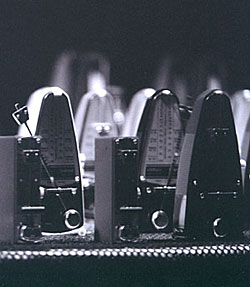 The
Instal event at the Arches, a one day festival of experimental electronic
and contemporary classical music and sequel to the Polaroid event
of 1999, repaid careful attention and made few concessions to hangovers
or ADHD attention spans. Seven hours of concession-free music was
evidently too much for some but the people who arrived fashionably
late missed probably the evening's highlight.
The
Instal event at the Arches, a one day festival of experimental electronic
and contemporary classical music and sequel to the Polaroid event
of 1999, repaid careful attention and made few concessions to hangovers
or ADHD attention spans. Seven hours of concession-free music was
evidently too much for some but the people who arrived fashionably
late missed probably the evening's highlight.  Philip
Jeck stood somewhere between the electronic and traditional
instruments on offer. (Strange sounds from strange sources or strange
sounds from staid sources.) Looking like a history teacher, shambling
between ten old record players, he built up his piece from fragments
of old records. For all the care he took in building his set up,
he showed no reverence for his artefacts, they are marked, scratched
and casually discarded when the sound fragment has looped its last.
It was most interesting to me when there were snatches of half-recognisable
sound in the mix. It took on a narcotic quality and the overall
effect was like dipping in and out of consciousness while listening
to a short wave radio set far down a factory corridor. What would
clubbing be like if he was as big a DJ as Paul Oakenfold?
Philip
Jeck stood somewhere between the electronic and traditional
instruments on offer. (Strange sounds from strange sources or strange
sounds from staid sources.) Looking like a history teacher, shambling
between ten old record players, he built up his piece from fragments
of old records. For all the care he took in building his set up,
he showed no reverence for his artefacts, they are marked, scratched
and casually discarded when the sound fragment has looped its last.
It was most interesting to me when there were snatches of half-recognisable
sound in the mix. It took on a narcotic quality and the overall
effect was like dipping in and out of consciousness while listening
to a short wave radio set far down a factory corridor. What would
clubbing be like if he was as big a DJ as Paul Oakenfold? 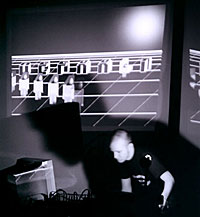 There
was a slight lack of visual spectacle that was slightly wearing
(despite a video programme for when your eyes got jealous of your
ears) but there were notable attempts to deal with this and break
down the passive audience-performer barrier. Glasgow's Defaalt
added visuals and interactivity to his show by offering the audience
the chance to play Space Invaders along to the music, definitely
an idea with potential beyond the slightly binary way it worked
in practice.
There
was a slight lack of visual spectacle that was slightly wearing
(despite a video programme for when your eyes got jealous of your
ears) but there were notable attempts to deal with this and break
down the passive audience-performer barrier. Glasgow's Defaalt
added visuals and interactivity to his show by offering the audience
the chance to play Space Invaders along to the music, definitely
an idea with potential beyond the slightly binary way it worked
in practice. | << back | index | top ^ |